The Announcement Is Not the Delivery Plan
The announcement is not the delivery plan. Learn to trace who must act, in what order, and which arrangements turn a policy promise into a usable service.
Who will do what after the announcement? To judge whether a policy is ready to reach people, look past the announcement and trace the tasks, owners, and handoffs that make delivery possible.
A statement of intent tells you what decision-makers want to happen. It does not necessarily tell you whether a service, payment, rule, or program is operating. Ask what must happen next, who owns each task, and what a member of the public can do now.
Promises and operations
An announcement often describes the intended change in public-facing language: a new service, expanded eligibility, a revised process, or more support. That language matters, but it can leave out the work between approval and use.
That work may include assigning staff, setting up intake, preparing guidance, adjusting forms, connecting records, notifying partners, and deciding how exceptions will be handled. If an announcement omits these details, look for an operational document or an accountable office. Missing details alone do not show that delivery has failed; they show what remains unclear to the reader.
Keep three questions separate:
- Authorization: Has an institution approved the policy or provided authority to proceed? If yes, look for evidence of preparation or operation next; if no, ask what decision is still pending.
- Readiness: Are people, procedures, systems, and instructions in place? If yes, check what users can do; if no, identify the task and office responsible for completing it.
- Access: Can an intended user find and use the service or process? If yes, follow the published route; if no, ask which channel or accommodation is missing.
These are different conditions. A policy can be authorized while staff prepare the process, or a service can be open while users still need clearer instructions. State which condition you mean to keep public discussion precise.
Responsibilities and handoffs
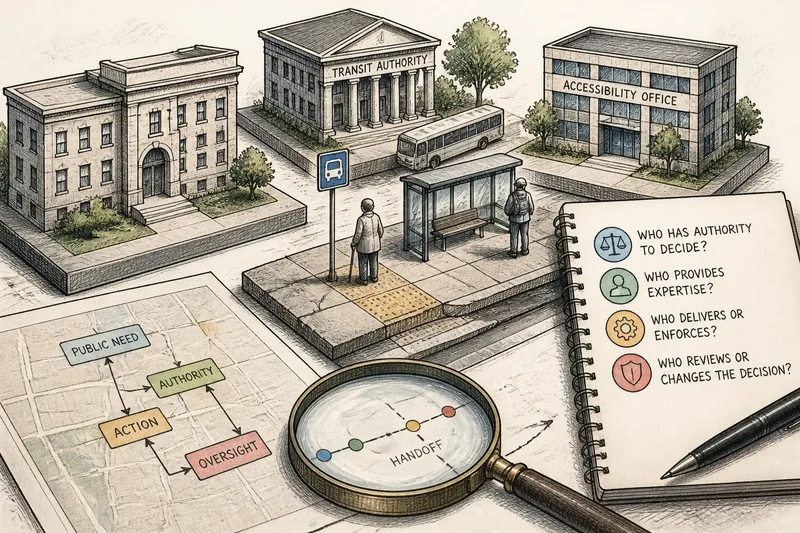
Look for a named owner at each handoff. A department may set policy, a regional office may coordinate it, a local agency may serve residents, and a contractor or community organization may handle a supporting task. Work can stall between institutions even when each has a general role.
Useful documents assign responsibilities with verbs, not just organization charts. Look for who will issue guidance, approve applications, answer questions, resolve disputes, maintain records, and report problems. “Partners will coordinate” says little unless the arrangement identifies who convenes them and what each partner provides.
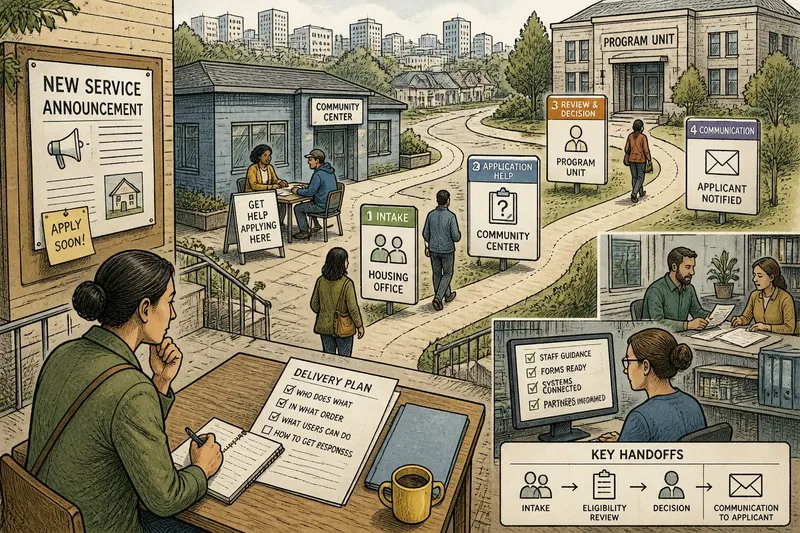
Trace one ordinary user’s route. Who receives the first request? Who decides whether it qualifies? If information is missing, who contacts the applicant? Who explains a decision? If a handoff has no clear owner, ask which office takes responsibility for it.
Imagine a city announces a home-repair assistance service. The public notice says residents can apply, but does not explain where. A later operating memo names the housing office as the intake owner, a community center as an application-help site, and another unit as the decision-maker. Following those steps, a resident can identify where to begin and which office handles the decision; the remaining question is how that office will communicate its response.
Sequence before launch
Delivery depends on tasks being completed in a workable order. Staff may need instructions before answering questions; a form may need to be ready before applications open; partner organizations may need referral information before directing people to the service. A launch date alone does not show whether those tasks are sequenced sensibly.
Look for milestones that describe completed work, not just broad aspirations. “Prepare staff guidance” is more informative than “support implementation,” especially if the plan says which team produces the guidance and which staff receive it. A clear sequence also helps distinguish preparation from public access.
Dates are useful only when you know what they mark: policy approval, publication of rules, staff readiness, opening of intake, or the point when a user can expect a decision. These events may occur at different times. If an announcement says “launching soon,” ask what people will be able to do first and where they will do it.
Operating arrangements
A delivery plan should make ordinary work legible. Look for how people enter the process, what information they need, how staff handle incomplete requests, and where questions go. These details may appear in program guidance, service pages, forms, staff manuals, or agreements with delivery partners rather than in a speech or press release.
Consider the service channels as well as the policy text. Is there a stated way to apply, request help, or check a decision? Are instructions available in formats and languages intended users can use? Is there a route for someone who cannot follow the standard process? These questions help show whether a public promise has become a usable service.
Operating arrangements also clarify boundaries. A program may be available only through a particular office, require a referral, or depend on another service completing an earlier task. Those conditions should be described plainly so people can understand the route and its limits.
When reviewing a document, check each item below. If the observation is present, follow the route it describes; if it is absent, record the unanswered question and ask the responsible office for the missing detail.
- Intake: Is there a named place or channel for requests? If yes, use or verify that route; if no, ask where requests should go.
- Decision owner: Does the document name the office that approves or denies requests? If yes, direct decision questions there; if no, ask which office makes the decision.
- Communications: Does it say how applicants receive updates or decisions? If yes, check that contact route; if no, ask how a person will hear back.
- Incomplete requests: Does it explain what happens when information is missing? If yes, follow those instructions; if no, ask whether staff will request more information or close the request.
- Exceptions: Does it describe a route for cases that do not fit the standard process? If yes, use that route when applicable; if no, ask which office reviews exceptions.
- Partner handoffs: Does it name who passes information or work to another organization? If yes, trace the next step with that owner; if no, ask which organization takes over.
Reading the delivery plan?
What counts as evidence of delivery?
Look for an operating service or process, such as an open application channel, published user instructions, or a named office handling requests. An announcement or authorization may be necessary, but neither alone establishes that people can use the policy.
Where should I look for responsibilities?
Start with the responsible department’s program page, implementation guidance, service agreement, or public contact information. If the material names no owner for a task, ask the department which office handles it and where that responsibility is documented.
How can I tell whether launch is near?
Look for completed readiness tasks and a clear description of what users can do at launch, not just a projected date. A date paired with an open intake route or published instructions is more informative than a date with no explanation of the service users will encounter.
What if a handoff is unclear?
Ask about the specific transition: who receives the request, who acts next, and how the person is informed. A focused handoff question is easier for an agency to answer than a broad request to explain the whole policy.
Questions worth asking
When a public statement draws attention, use these checks to distinguish intent from operating detail:
- Owner: Which office is accountable for the next action? If named, contact that office about its task; if not, ask who owns it.
- Sequence: What must happen before the public can use the policy? If those tasks are listed, identify the pending one; if not, ask what remains before access opens.
- Access: Where can a person apply, ask for help, or receive a decision? If the route is clear, follow it; if not, ask for the correct channel.
- Handoff: Which institution or team takes over when the process moves? If the next owner is stated, direct the follow-up there; if not, ask which team receives the work.
- Exceptions: What happens when a request does not fit the standard route? If an exception process is described, use its instructions; if not, ask who reviews unusual cases.
- Current status: Is the policy approved, being prepared, accepting requests, or operating? If the status is explicit, use that stage to frame your next question; if not, ask what users can do now.
These checks work in public meetings, agency notices, budget documents, and conversations with service providers. Ask one question at a time and tie it to a task or user route. This keeps the discussion focused on delivery rather than turning it into a general argument over whether the policy sounds worthwhile.
The announcement is not the delivery plan; the practical test is whether you can trace responsibility from the decision to the person expected to act. When you cannot, name the missing handoff and ask which office owns it. That distinction helps residents, reporters, and public officials identify what is happening now and what still needs to happen before the promise reaches its intended users.