The Evaluation Question That Changes the Answer
Policy evaluation depends on the question asked. Learn to distinguish implementation, outcomes, and the original aim before judging a public program.
What does a policy evaluation actually tell you? The answer depends on whether the review examines implementation, outcomes, or the original aim. A report can be careful and still leave a reader with the wrong conclusion if its question is mistaken for a broader verdict.
That distinction matters when a program is criticized, renewed, redesigned, or described as successful. Before reading its headline finding, look for the question the reviewers set out to answer. It defines what evidence they gathered, which comparisons they made, and what their findings can reasonably support.
Three questions, three answers
Evaluation is not a single test that produces one final judgment. It is a way to examine a public intervention from different angles. Each angle can be useful, but none automatically answers the others.
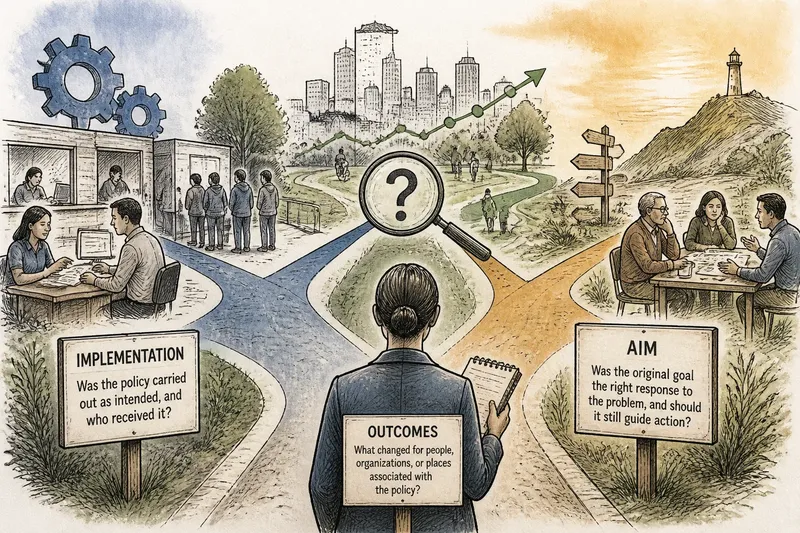
- Implementation: Was the policy carried out as intended, and who received it?
- Outcomes: What changed for people, organizations, or places associated with the policy?
- Aim: Was the original goal the right response to the problem, and should it still guide action?
A review focused on implementation may clarify whether a service was available, eligibility rules were applied, or local offices had the capacity to deliver it. A review of outcomes may examine changes that followed. A review of the aim may ask whether the policy addressed the problem it set out to address, or whether the public objective should be reconsidered.
These questions connect, but they are not interchangeable. A service may be delivered as designed without changing the outcome. An outcome may improve while access remains uneven. And a policy can meet its stated target while the target itself proves too narrow to address the underlying concern.
Read the review question
Start with the report’s purpose, scope, or evaluation questions. These may appear in an executive summary, methods section, terms of reference, or a statement of the review’s limitations. Search for verbs that signal the task: implement, reach, change, reduce, improve, or assess.
Then match the question to the evidence. A review asking whether eligible applicants received a service might draw on administrative records, interviews, or case files. A review asking whether the service changed an outcome may need a comparison over time or between groups, along with a reasoned account of other influences. A review asking whether the aim remains appropriate may rely on a different mix of evidence, such as updated problem analysis, public priorities, and the fit between the policy and the need it addresses.
The method does not answer every question merely by appearing in a report. Instead, it sets boundaries. For example, records can show whether applications were processed, but that alone cannot establish whether the policy improved people’s circumstances. Interviews may explain why a program was hard to use, but they do not automatically show how common that experience was.
Check whether the report distinguishes what it observed from what it inferred. A finding such as “the service reached many intended users” describes access. “The service caused the observed improvement” makes a stronger claim about effects. The second needs evidence that can support a causal explanation, not simply a record that change occurred after the program began.
Implementation findings
An implementation review looks at the path between an authorized policy and what people encounter. It may examine whether staff understood the rules, whether the service was available in different locations, or whether the process created obstacles for intended users.
This kind of review can expose a gap between written design and everyday practice. Suppose eligibility is formally clear but the application process is difficult to complete. A review might identify that as a delivery problem. That finding can justify changing forms, communications, staffing arrangements, or support—not necessarily abandoning the policy’s objective.
Implementation evidence also helps interpret a disappointing outcome. If the service did not reach the people it was intended to serve, weak results do not tell you whether the underlying approach would work under adequate delivery. But the reverse deserves equal care: an implementation problem should not become a permanent excuse for poor outcomes. Decision-makers need to ask whether the delivery barriers can realistically be addressed and then examine what happens after changes are made.
Look for details about variation. A program may operate differently across regions, agencies, or groups of users. An average description can conceal that some people received the intended service while others faced delays or exclusion. The relevant question is not only whether the policy existed, but how its delivery differed and why those differences matter.
Outcome findings
An outcome review asks what changed and how plausibly that change relates to the policy. The outcome should be defined in terms that match the public purpose: for instance, whether access improved, a harmful condition became less common, or a service became easier to obtain.
Changes can have several explanations. Economic conditions, other public programs, demographic shifts, or changes in how information is recorded may affect the same outcome. A careful evaluation considers these alternatives instead of treating a before-and-after difference as a complete account.
It should also distinguish immediate outputs from broader outcomes. A training session delivered, a permit issued, or a grant awarded is evidence of activity. It does not by itself show that the intended condition changed. Outputs can still matter: they help explain whether the policy was put into practice and where the chain from activity to result may have broken.
Consider who benefits and who does not. A policy’s overall result may look favorable while access or effects differ across communities. Disaggregated findings, when appropriate and responsibly collected, can help reveal these differences. They should be interpreted with attention to context and privacy, rather than treated as automatic proof of why a gap exists.
Revisit the original aim
Evaluation can also question the policy’s starting point. An aim may have been framed too narrowly, may no longer reflect the problem people face, or may leave out an important group. This is not the same as asking whether administrators followed the rules or whether a particular outcome changed.
To assess the aim, look at how the problem was defined and whose experiences shaped that definition. Ask whether the stated objective describes a public condition or merely an administrative activity. “Process applications faster,” for example, names a task; it does not, by itself, say what public problem faster processing is meant to address.
Reconsidering an aim does not mean that every evaluation should reopen the policy’s purpose. It means recognizing when a review has evidence relevant to that choice and when a separate public decision is needed. Revising the objective may involve trade-offs among needs, rights, feasibility, and public priorities that technical findings alone cannot settle.
Nor does a policy miss its purpose simply because it fails to meet one indicator. The indicator may be incomplete, poorly aligned, or insensitive to the change that matters. Read the definition and limits of the measure before treating it as the whole objective.
Match claims to evidence
When a report reaches a broad judgment, separate its claim into parts. Does it say the policy was delivered? That outcomes changed? That the policy caused the change? Or that the objective remains worthwhile? Each statement needs a corresponding basis.
- For delivery claims, check records of access, service quality, consistency, and barriers.
- For outcome claims, check what changed, for whom, over what period, and against what comparison.
- For causal claims, check how the review considered other explanations for the change.
- For claims about the aim, check whether the report examined the problem and the objective, rather than only the program’s activity.
Also note the difference between “not observed” and “did not happen.” A review may lack data for some groups or outcomes, or its scope may exclude a question. That leaves uncertainty; it does not settle the question in the negative. A report’s limitations are part of its findings because they show where a decision-maker should avoid overclaiming.
Imagine a city offers a new appointment service for residents seeking help with housing forms. A review finds that staff used the service as planned and residents who completed appointments made fewer errors on their forms. That supports claims about implementation and an immediate outcome. It does not, on its own, establish that residents secured stable housing or that the city chose the right response to housing insecurity. The next review would need to ask those distinct questions, using evidence suited to each.
Which question matters now?
Can implementation succeed without better outcomes?
Yes. A program can be delivered consistently while the approach has little effect on the outcome, or while outside conditions overwhelm its influence. That finding points to a need to examine the policy design and its assumptions, not just delivery.
Does a better outcome prove the policy caused it?
No. The change may have other explanations, including concurrent services or broader shifts. The review needs a suitable comparison and a clear account of alternative causes before making a causal claim.
Can an evaluation question the policy’s aim?
It can, if the review is designed to examine the problem definition and objective. A review limited to service delivery or measured outcomes may not provide enough evidence to decide whether the aim should change.
What if the report leaves the question unclear?
Look for the stated scope, methods, and limitations, then describe the finding narrowly. If the report does not say whether it studied delivery, outcomes, or the aim, ask the responsible agency to clarify what decision the evaluation was designed to inform.
Use findings for decisions
A review is most useful when its question fits the decision in front of the public agency. If officials need to know why people cannot access a service, implementation evidence is central. If they must decide whether the intervention is changing a public condition, outcome evidence matters. If the problem or objective itself is in dispute, the review must examine that foundation rather than treating a delivery metric as a substitute.
Policy evaluation becomes easier to read once you identify its question. Keep the distinction in view when a headline turns one finding into a verdict: ask whether the evidence concerns implementation, outcomes, or the original aim. That small pause makes the report’s real contribution—and the decision still left to make—clearer.