Why Public Agencies Have Distinct Roles
Why public agencies have distinct roles: learn how to spot clear accountability, identify coordination gaps, and decide which institutional boundary needs attention.
Why public agencies have distinct roles becomes clear when a resident asks who can actually resolve a problem: the city, a state department, or a federal office? The answer depends on which institution has authority, relevant expertise, and a workable connection to the others—not simply which agency is easiest to find.
Separate public responsibilities can make decisions more accountable by giving each institution a defined job. But boundaries also create handoffs. To assess an arrangement, start with the situation you face: a responsibility is unclear, several agencies share a task, or one body needs to check another. Each calls for a different response.
When ownership is unclear
If people cannot tell which agency is responsible, look for a gap between a public need and the authority assigned to address it. A department may handle permits while another oversees the facility those permits affect. The public encounters one issue; government has divided it into separate functions.
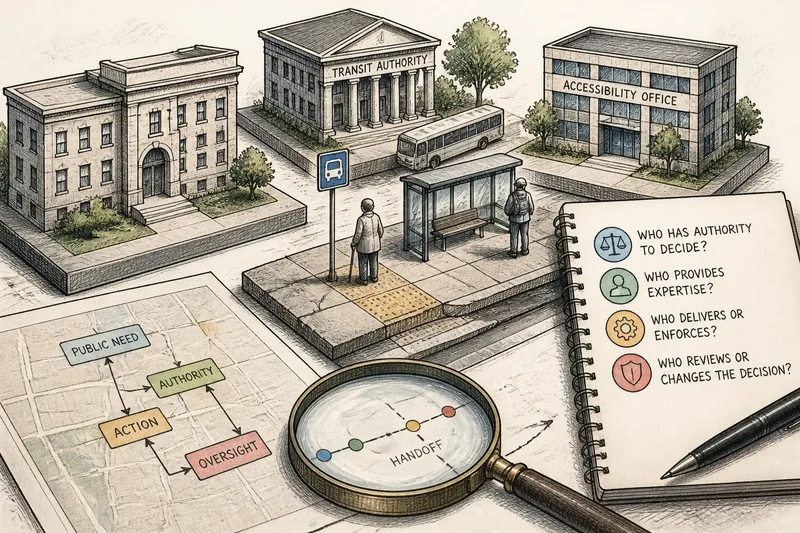
In this situation, trace the decision rather than relying on agency names. Ask:
- Who has legal authority to make the decision?
- Who gathers information or provides technical advice?
- Who delivers the service or enforces the requirement?
- Who can review a complaint or change the decision?
These functions may sit in different institutions, and that division is not automatically a flaw. A specialist agency can apply expertise consistently, while another body handles local implementation. The concern is whether each task has an identifiable owner and whether the public can find the right route between them.
Say you are trying to understand a blocked sidewalk near a bus stop. Imagine the city maintains sidewalks, a transit authority operates the stop, and a separate office handles accessibility complaints. Your first useful question is not which agency is to blame; it is which office can authorize the repair and how the complaint reaches it. A clear public directory or referral process would let each institution keep its distinct role without leaving the resident to guess.
When functions are divided
Some responsibilities are separated because they require different capabilities or because decision-making power should not sit entirely in one place. A public health office may set technical guidance, a local department may deliver inspections, and an elected body may approve the rules or budget. Each has a different kind of responsibility.
This arrangement fits when the work has genuinely different parts. It can also help make choices visible: elected officials set broad priorities, professional agencies apply specialized judgment, and oversight bodies examine whether authority is being used properly. The point is not to create as many offices as possible. It is to assign each function to an institution that can perform it and be held answerable for it.
When assessing a division, distinguish authority from influence. An agency may advise another without having the power to decide. A contractor may carry out a task without setting the public standard. A board may review an action without managing the service. Treating these roles as interchangeable makes accountability harder to follow.
When agencies must coordinate
If a public outcome depends on several institutions, the issue is often not whether to merge them. It is whether they have a dependable way to connect their work. Separate agencies may need to share records, refer cases, align schedules, or resolve conflicting instructions.
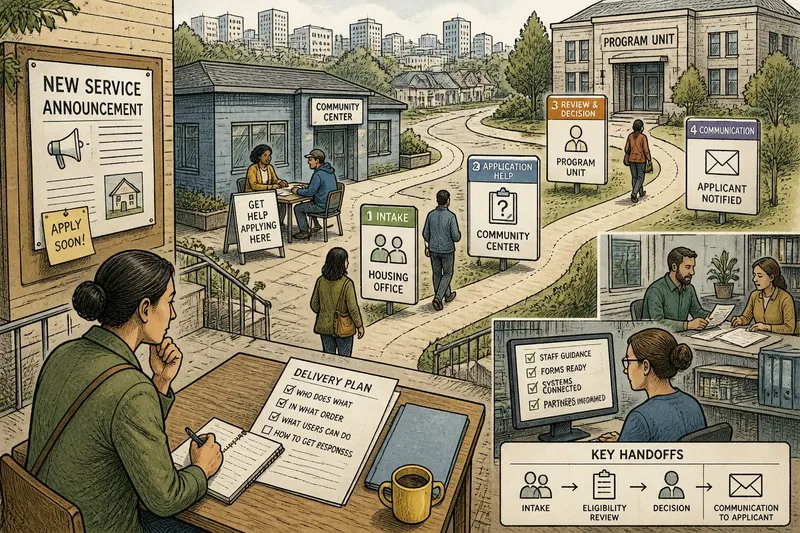
Look for the handoff where work can stall. Who sends the information? Who receives it? What happens if the receiving office cannot act? A coordination arrangement is more useful when it names a contact, defines what information can be shared, and gives unresolved cases a route for escalation. A joint committee can help, but meetings alone do not clarify who is responsible for the next decision.
Choose this approach when each institution has a distinct mandate but the task crosses their boundaries. Avoid treating every delay as evidence that one office should absorb the others. Consolidation can simplify a chain of command, yet it may also weaken specialized judgment or remove an independent check. The fit depends on the source of the problem: a missing connection calls for coordination; duplicated authority or persistent conflict may call for a clearer assignment.
When oversight matters
Some roles are deliberately separated so that the institution delivering a service is not the only one judging its performance or conduct. An inspector general, auditor, regulator, or review board may have a different mandate from the program office. That distance can make scrutiny more credible, provided the oversight body has access to relevant information and a defined way to report concerns.
This arrangement fits when decisions affect rights, public funds, safety, or access to services and need independent review. Ask whether the reviewer can examine records, explain findings, and refer problems to an authority that can act. Oversight is not the same as day-to-day management: a reviewer may identify a failure without having the power to run the program or order a particular remedy.
For a reader trying to resolve an individual issue, distinguish an appeal from a complaint about conduct. An appeal usually asks whether a decision should change under the applicable rules. A complaint may ask whether an office followed proper procedures. The agency’s published process should identify the route; if the stakes are significant, a qualified adviser can help interpret the options.
Which institutional fit applies?
Who owns an unclear decision?
Start with the institution that has authority to make or change that decision, not merely the office that answers the phone. If the published information does not identify that authority, the problem is a responsibility gap that calls for a clearer assignment or public referral path.
Why do agencies share a task?
Check whether the task contains different functions, such as setting standards, delivering a service, and reviewing compliance. If those functions need different expertise or independence, a divided structure may fit; if the split has no clear purpose, it may obscure responsibility.
Where does a handoff fail?
Follow the information or request from the first office to the next and identify where it stops. If each agency’s role makes sense but the connection is weak, improve the referral, shared process, or escalation route rather than assuming that the institutions need to merge.
Who checks the decision-maker?
Look for a reviewer with a distinct mandate and a clear way to examine the decision. If no independent route exists where one is needed, the issue concerns oversight; if a reviewer exists but cannot obtain information or send findings onward, the connection to corrective authority needs attention.
Read the boundary carefully
To assess why public agencies have distinct roles, match the arrangement to the actual problem: unclear ownership calls for a named decision-maker, divided functions call for visible accountability, failed handoffs call for coordination, and unchecked authority calls for meaningful oversight. These are different institutional questions, even when they surface in the same public service.
When a responsibility depends on legislation, an agency charter, or local procedures, consult the official documents or ask the relevant office to identify its authority. A simple way to test the explanation is to ask who decides, who acts, who passes information, and who can review the result. If each answer points to a specific institution and a usable connection, the boundary is doing useful work; if one answer disappears between offices, that is the part worth raising.